Wednesday, October 31, 2012

National Turf Evaluation Program and the Southeast


Crabapple LandscapExperts provide the cutting edge of lawn care and turf information for our commercial and residential customers. Some of the research available is available through Executive Director Kevin Morris of the National Turfgrass Evaluation Program, that regularly publishes the results of the National Turf Evaluation Program NTEP.  The entire report (including data)on Tall Fescue is available, while data fromprevious trials is also available.  

UGA Turf Specialists run turfgrass trials at the Griffin, Georgia Experiment Station and contribute their data to the final evaluation from the Georgia perspectiveSpecific to the metro-Atlanta area that Crabapple covers, fescue varieties Rhambler and Monet were designated top performers for Georgia and earned top honors for the southeast.

Crabapple Landscape Experts consider many aspects of turf grass varieties evaluated in the NTEP Guide to Quality : 
Genetic Color 
Winter Color
Seasonal Color and Color Retention
Spring Greenup
Leaf Texture (leaf width from coarse to fine)  
Density of the turf (plants and tillers or sideshoots)
Living Ground Cover (spread during the growing season)
Seedling Vigor/Establishment  
Resistance to Disease or Insect Damage
Quality under shade   
Traffic Tolerance /Compaction  
 Drought Tolerance  
Thatch Accumulation
Sod Strength
Mowing Quality or “Steminess  
Seedheads  
Resistance to Poa Annua Invasion
Frost Tolerance or Winter Kill

To discuss renovating the turf on properties you manage, contact your Crabapple LandscapExpert Rep at 770-740-9739. 

Wednesday, October 24, 2012

4 Types of Hydrangeas


Mophead type Hydrangea

CrabappleLandscapExperts use these four types of Hydrangeas as easy-care flowering deciduous shrubs for shade or partial sun. The botanical name, Hydrangea, is based on "Hydro" meaning water, giving an indication that these woody ornamentals prefer moist soils. The LandscapExperts plant them where there is enough moisture in the soil that they will thrive.

Lace Cap
 Bigleaf a.k.a. Macrophylla Hydrangea
These are the familiar pink- or blue- flowered, deciduous shrubs that most people grew up with, and that tolerate shade and still flower profusely. They can be divided into 
  • Mophead composed of all sterile florets that look like balls, or 
  • Lacecap, a flatter style, which have an outer rim of sterile florets while the centers are composed of tiny fertile flowers (like an old fashioned lady’s lace cap). Bigleaf Hydrangeas are great as cut flowers or dried for autumn arrangements.   

Hydrangea arbroescens
 Arborescens  a.k.a. Annabelle Hydrangea
Native to North America, Annabelle Hydrangeas are large shrubs with huge, flat white flower heads to 10” in diameter. They are hardy and bloom in cold or hot areas, and so  easy to prune they are sometimes used as hedges.


Vanilla Strawberry variety
PeeGee  Hydrangea
P.G. stands for “paniculata Grandiflora” also large shrubs but with cone-like or panicle-shaped blooms. Limelight is a popular cultivar, with strong stems and blooms opening chartreuse and finishing white. Vanilla Strawberry is a yummy new cultivar with white cones changing to a compelling strawberry pink, although it remains to be seen whether or not the branches are strong enough to hold up the flower heads.  
Fall color, Oakleaf Hydrangea*
Oak leaf Hydrangea
Our favorite hydrangea is the native Oakleaf known as quercifolia (after Quercus for oak) known for  four seasons of beauty!  Oakleaf hydrangea leaves are notched and loosely resemble oak leaves; they are a leathery green in summer but turn brilliant red or deep maroon in autumn. In winter after the leaves fall, the bark exfoliates or peels in cinnamon strips; in spring, the new growth is silvery green.  The large white cones ornament the shrubs in summer, double or single white, then turning a soft pink and finally then fading to a rusty rose. 
This versatile genus provides many options for today's landscapes. Look for our upcoming About.com gardening video about these 4 types of Hydrangeas. 

 * oakleaf hydrangea leaves photo thanks to Peggy Singlemann, Maymont blog  

Wednesday, October 17, 2012

Steel Edging of Landscape Surfaces, Part 2


Unobtrusive steel edging strip between path and bed

Although the typical property manager or resident may not realize just why a Crabapple landscape looks so great, our crisp edging of lawns, paths, gardens and flower beds plays a big role in maintaining the desirable tailored look.  One method of edging is Trench Edging or Air Root Pruning.  

Another edging option we recommend is mechanical metal edging. 

Steel edging provides a lasting landscape edge for commercial and residential projects, ideal because of its strength, durability and flexibility.  The steel edge that defines the interface between landscape surfaces helps in mowing and creates a well-groomed, well-defined look along the borders.

Benefits of Steel Edging
  • Clean lines 
  • Minimal intrusion 
  • Will not rot, chip or become brittle in cold weather 
  • Withstands routine landscape maintenance with its uniform thickness and weight 
  • Protects trees from “string trimmer and lawnmower blight” 
  • Installs quickly and easily, for straight runs or curves 
  • Keeps disparate materials like pebble paths and pine straw beds separated

Brick edging for turf
Another method of mechanical edging is by the use of bricks set in mortar to provide a mowing edge. Consult your Crabapple Rep to discuss this type of feature.

Our LandscapExperts wear protective footwear and eye protection, and follow the manufacturers’ safety instructions. Crabapple LandscapExperts has a great safety record of working smart and efficiently for you.  

Wednesday, October 10, 2012

Eliminating Stinging Fire Ants


Fire Ant, UGA Center for Urban Ag
After the heavy rains metro-Atlanta landscapes enjoyed, Crabapple LandscapExperts are finding that fire ants are surging to the surface with mounds that look like volcanoes of brown sugar and that destroy both the comfort and smoothness of a fine lawn.

Death to Fire Ants
The culprit is the imported red fire ant, Solenopsis invicta, a potent pest in the properties you manage. Fire ant colonies affect the smoothness of turfgrass, and invade gardens, compost piles and even buildings and homes. Fire ants have a painful sting and when a colony is disturbed, hundreds of ants swarm out of the nest to attack the offending child or pet, causing multiple bites that burn like stings and are followed by an itchy rash.

IFA Range of Infestation-ARS USDA.gov
Persistence is Key to Fire Ant Extermination  

At right, fire ants infest the southern U.S. (pink) and potentially threaten the far west (green). Fire ant extermination is not a one-time treatment, but a consistent, planned control program that takes diligence and determination on the part of the LandscapExperts Team at Crabapple.

Apply Now
The best time to apply fire ant control is after a heavy rain and in spring or fall when queen and brood are close to the surface and worker ants are actively foraging for food. Crabapple recommends a two-phase method ofcontrol endorsed by the University of Georgia and by agricultural colleges across the country. At Texas A & M, this follow-up method ofcontrol is called the “Texas Two-Step”.
Best coverage requires 1.) broadcast application of poisonous bait to which ants are attracted that they pick up and carry into their colony, followed by 2.) spot treatment with a contact pesticide, whether chemical or organic.
Stage 1 Control- Broadcast Bait
The first step recommended by University of Georgia entomologists is to broadcast a bait insecticide over the entire infested area. Crabapple uses fresh bait and applies it when the ground and grass are dry. Appealing to ants, processed corn grits coated with soybean oil have ant-killing pesticides added and are broadcast at a very low rate of 1 to 1.5 pounds per acre (!) . Unsuspecting fire ants carry this tainted ‘food’ into their colonies. This ant-assisted delivery system targets workers, queens and brood (eggs, larvae and pupae) inside the mounds. Bait-treated mounds will eventually die out and will keep new fire ant queens from re-infecting the area but the approved method is to follow baiting with a one-two knockout punch.
Stage 2 Control- Spot-Treat Threatening Mounds
Fire Ant Hill 8 inches tall! 
After allowing the bait time to work (about 3 days to a week), Crabapple implements Stage 2 control. The second phase of fire ant control involves spot treatment of threatening mounds next to high-traffic areas such as playgrounds, sidewalks, dog runs and building foundations. This second step uses one of several approved products labeled for fire ants that kills them on contact. The choice of products includes drenches, granular products, liquid fumigants and injectable products. Your Crabapple Rep can recommend the best product for your particular property.
Contact Methods include:
  • Drenches requiring one to three gallons of the solution to treat a single mound 
  • Injectable products applied with a rod injector to the center of the colony 
  • Products that combine with water and volatilize into a “heavier-than-air” gas that sink into the mound and fumigates it 
  • Organicpesticides such as pyrethrin insectide that is harmless to warm-blooded pets and people or citrus, orange oil-based pesticides 

Better than 90% control in 10-12 weeks
UGA research shows that the use of this one-two knockout plan, first broadcasting a bait and then spot-treating problem mounds, produces a greater than 90 percent success rate within 10 to 12 weeks. Crabapple recommends repeating this 2-Stage program on a regular schedule, or else the area will become re-infested by incoming mated fire ant queens within six to twelve months. To keep your property free of fire ants, we recommend repeating the broadcast bait application every six months and spot treatment of individual mounds., Let your LandscapExperts Rep arrange to eradicate fire ants on your properties now. 
photos thanks to UGA Centre for Urban Ag, USDA, Geri Laufer
Digging Deeper 
A hilarious and fascinating (to landscape geeks) Post by Dr. Sanford Porter, a researcher at the USDA-ARS Center for Medical, Agricultural and Veterinary Entomology in Gainesville, Florida mentions dozens more ways to kill fire ants.

And Deeper
A trailer about making the Giant Amazon Ants sequence in Indiana Jones and the Crystal Skull 

Wednesday, October 3, 2012

Trench Edging or Air Root-Pruning for Lawns


A great landscape has a well-manicured look that results in large part from a neat and crisp edge between lawn areas and shrubbery, flower beds or paving. Crabapple LandscapExperts have state-of-the-art equipment to give your turf areas a clean edge.

Turf grasses spread rapidly by above- and below-ground runners that are difficult to control around flower beds, borders, walks and paving. For many properties we recommend trench edging for lawns.

Benefits of Trench Edging
  • Natural looking
  • Economical
  • Clean and crisp
  • Does not chip and biodegrade (as with plastic edging)
  • Catches mulch from flower or shrub beds (preventing it from spreading onto the lawn)
CrabappleLandscapExperts run a mason string line for your initial edge and use a hose or spray paint for your curves. Using the latest equipment we then make a V-shaped cut between the turf and the flower bed, cutting straight down next to the grass and with an angled cut from the flower beds or paving. This results in a shallow 3-4 inch trench. Excess soil is directed into the adjacent bed. When the roots of grass hit the trench they are “air root pruned,” thus stopping turfgrass stolons from invading the flower bed or growing over the sidewalk or curb. Air root pruning is a well-accepted horticultural technique.

As with many landscaping techniques, the key to keeping a tidy edge is upkeep and maintenance throughout the year. Arrange for your edging project with your LandscapExpert

photo credit Steve Thompson 

Wednesday, September 26, 2012

When to Prune - Timing for Rejuvenation Pruning

Loping shears for large branches

Shrubs are a valuable part of the landscape, filling the niche intermediate between lawn and trees. Shrubs are planted for their ornamental characteristics such as flowers, foliage, fall color, or fruit. Proper pruning by Crabapple LandscapExperts maintains plant health, controls or shapes plant growth and stimulates flowering. 

Many deciduous shrubs (the ones that lose their leaves in fall plus broadleaf evergreens) can be kept healthy and vigorous by removing a few of the oldest, thickest stems every couple of years. If this process is neglected shrubs become leggy and overgrown, and then rejuvenation pruning is needed.

Botanically Speaking
A shoot consists of a stem with a growing tip and leaves. When the growing tip is removed (pruned) then dormant, lateral buds at the base of each leaf are stimulated to grow, and the branch becomes more “bushy”. Dormant buds at the base of the shrub can also begin growth if older branches are removed at ground level.

Timing
Rejuvenation pruning is best accomplished while the shrubs are dormant- late fall through late winter. Consult your Crabpple Rep now for scheduling.

Methods
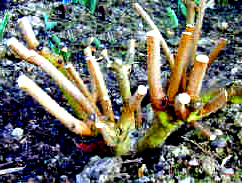
One technique used by our Crabapple LandscapExperts is to selectively remove one-third to one-half of the large overgrown branches from the base of the plant using long-handled lopers. This stimulates dormant buds to grow, producing vigorous young branching from the base.

Holly stumps will soon resprout
A drastic method we employ with success for hugely-overgrown hollies for example is to cut them back to 6 inches from the soil using a chain saw (!) on the trunks. This leaves large unsightly stumps-- but only for 3-4 weeks, until dormant buds begin to grow. Soon, within 6 to 8 weeks, a beautiful, small young holly replaces the former encroaching giant. Afterward, arrange for your LandscapExperts to take care that they are properly pruned and maintained in future.

Conifer Caution
Large, overgrown evergreens are a more difficult problem. It is sometimes best to remove overgrown junipers or arborvitaes and other evergreens that cannot be pruned back severely because they will never re-grow new shoots. Junipers for example, have a large dead zone in the center with few dormant buds that cannot be stimulated to grow. Crabapple techs know never to remove all the greenery from a juniper branch because no new branches will be initiated from bare wood. In this case, your LandscapExpert will suggest removal and replanting with appropriate shrubs.

For more pruning strategies, contact your Crabapple LanscapExperts Rep at 770-740-9739.  

Wednesday, September 19, 2012

8 Reasons for Rejuvenation Pruning of Drastically Overgrown Shrubs


Are overgrown shrubs draped across windows or overhanging sidewalks on the properties you manage?  Correct and timely pruning is essential for proper maintenance of commercial and residential landscapes.

Trees and shrubs should be examined annually and your Crabapple LandscapExperts Rep can help with this. If pruning has been overlooked for several years, or if previous maintenance companies have sheared the plants into “green meatball shapes” over the life of the community, Crabapple can remedy the problem. Winter is the best time to take care of remedial pruning. During this time of year, Crabapple can cut back severely, in some cases 50%) without worry to reduce the size of overgrown plants. 

To prune successfully, Crabapple LandscapExperts 1.) knows why to prune, 2.) knows when to prune and will suggest the correct timing, and 3.) knows how to prune and you can rely on us to follow the correct techniques. 

8 Top Reasons to Prune

Crabapple LandscapEXPERTS know that pruning is necessary to maintaining a healthy, vigorous tree or shrub.

1. Maintain or reduce plants to manageable size—pruning can prevent a plant from overgrowing its spot in the landscape and intruding on sidewalks or obstructing buildings or windows.

2. Eliminate dead, diseased or broken branches- maintain shape, vigor and health of handsome mature greenery

3. Reveal the true shape of shrubs- restore the graceful natural beauty of shrubs that have been sheared into squares or cubes in the past or "inverted" hedge pruning that shades out bottom branches

4. Remove undesirable growth- removal of weak, overcrowded growth and crossing or rubbing branches to open up the center of the shrub and improve air circulation inside the plant. 

5. Rejuvenate and restore old plants to vigorous growth – youthful, natural growth habit

6. Prevent damage to life and property- hazards to property, painted facades and overhead wires can be eliminated by proper pruning

7. Improve security - overgrown shrubs can conceal unauthorized break-ins at vulnerable points like windows 
8. Stimulate flowering and fruiting- new wood is younger and often more floriferous

Call your Crabapple LandscapExperts Rep to schedule an evaluation of overgrown shrubs and trees on the properties you manage and suggest the appropriate treatments. Our phone number is 770-740- 9739, and thank you!