Wednesday, April 3, 2013

Mulch Madness: Mulch Volcanoes are Proven Tree Killers


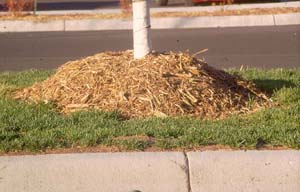
Bad Practices: Classic Mulch Volcano (UMN.edu)
 "If a little is good, more must be better" does not hold true with everything. Fertilizer for example, where a little is beneficial but too much can burn plant roots. And while rings of mulch surrounding woody ornamentals serve to (1.) protect the trees and shrubs from string trimmers, (2.) maintain moisture around the root zone, and (3.) visually set off specimen plants in the landscape, any good thing can be carried too far.  Crabapple LandscapExperts warn that "mulch volcanoes" are not the way to go when mulching woodies.

Easy Does It
Too Much Mulch
"Mulch volcanoes" are a protective ring of mulch gone mad. Heaping cones of mulch packed around the trunk of trees and shrubs and pushed right up against the bark is the wrong approach. Bark is the tree's outermost protective layer, and needs to be exposed to air. Moisture from constantly-moist, piled up mulch softens bark causing it to be susceptible to several bad actors, including:
  • Wood-boring insects living in the mulch can tunnel through to the softened, partially-decomposing bark and gain easy-access to the greenwood or vascular tissues beneath the bark, introducing vectors of disease. 
  • Diseases such as harmful fungal canker diseases (rots), bacterial attacks or virus diseases can more easily penetrate to the interior of the plant when the bark remains continually moist. 
  • Critters such as mice and meadow voles can tunnel through the mulch and chew through the outer bark to reach the tasty living inner bark. This will cut off the flow of water up from the roots and nutrients down from the leaves, causing the plant to die.
  • Roots tend to migrate up toward the top of the mulch layer during rainiy periods, only to dry out when summer drought sets in.
On the Other Hand
 In times of drought, such a thick "volcano" of mulch a foot high can prevent rainfall or irrigation water from reaching the root system in an "umbrella" system, causing additional plant stress.

LandscapExperts Recommendations

Mulch Ring Size
A mulch ring can be a radius about 2 to 3 feet out from the trunk, or can go all the way out to the canopy's drip line. This ring provides a protection zone for the roots as well as for the trunk.
Depth
Two to three inches of organic mulch is plenty, since thicker layers inhibit the exchange of oxygen between the tree roots and the atmosphere, since roots need air as well as water to remain healthy. Leave a space 2 - 3 inches between the bark and the beginning of the mulch for good air circulation.
Material
Compost, well-rotted wood chips and pine straw work well and contribute to the organic content of the soil as they break down over time. Crabapple LandscapExperts do not recommend rubber mulches or dyed mulches because of reduced air and moisture supply and the release of toxic chemicals. Neither should fresh wood chips or sawdust be used, since they temporarily rob the tree of nitrogen during the process of decomposition.

Contact your Crabapple Rep to discuss using proper mulch rings to highlight specimen trees and shrubs in the landscapes you manage.

Digging Deeper:
University of Georgia weighs in on Mulch Volcanoes:
http://apps.caes.uga.edu/urbanag/Home&Garden/indexFS.cfm?storyid=2710


Wednesday, March 27, 2013

Treat Yellowing Leaves on Broad-leaved Evergreens


Are your Camellias or Hollies showing yellowed leaves this time of year? Some leaves are naturally aging and yellowing. Other plants with yellowed leaves have a condition known as chlorosis and may include Pieris, Illicum, Rhododendron, Camellia, Ilex (Holly), Gardenia and other broad-leaf evergreens. The yellowing is typically due to one of two causes. The plants may need a Nitrogen fertilizer or they may need the application of the micronutrient Iron. 

This yellowing of foliage or chlorosis can also occur in potted houseplants such as Citrus, Ficus and Jasminum. 

How to tell?
CrabappleLandscapExperts will examine the plants carefully.

Nnitrogen Deficiency, Flordia.edu

Nitrogen Deficiency
When a plant lacks the macro-nutrient Nitrogen, older or lower leaves will yellow uniformly and often drop. The plant will transfer available nitrogen to its growth tips and new leaves.


Nitrogen Treatment
The LandscapExperts add Nitrogen by adding organic sources such as compost, well-rotted manure, fish emulsion, or commercial fertilizers. Water-soluble fertilizers designed as foliar feeders are easily mixed and sprayed onto the foliage. We also ensure that adequate Nitrogen fertilizer penetrates the soil and root ball. Our mixtures that are high in Nitrogen, denoted by the first number in the formula. The LandscapExperts always follow the directions for application to avoid over-feeding that can damage plants.


Iron Deficiency, Cornell.edu
Iron Deficiency
On the other hand, Iron deficiency symptoms are first expressed in the new growth or young leaves. Iron-deficient leaves show a characteristic inter-veinal chlorosis, with the leaf blades turning pale green to yellow, but the veins remaining dark green. Iron deficiency often goes along with Zinc and Manganese deficiencies, and these are all micronutrients that plants need for good growth. The new leaves are not producing enough green chlorophyll because of the lack of the essential micro-nutrient, Iron, which is a component of the chlorophyll molecule.

Iron Chelate Treatment
Iron Chelate (pronounced KEY-late) is a nutritional supplement that provides a soluble source of “liquid iron” that is immediately accessible to plants. It is commonly used as a foliar spray to treat the symptoms, and provides quick and easy correction of iron deficiencies. The leaves typically green up in less than a week! Liquid Iron is chelated iron with copper, manganese and zinc. A small amount goes a long way, particularly for potted plants -- only a 1/2 teaspoon per quart of water is advised.

Fast-acting Iron Chelate is often mixed with seaweed and other organic formulations as a broad spectrum tonic for plants. Repeat monthly. It aids in the production of vigorous dark green plant growth and corrects micro-nutrient deficiencies.


Wednesday, March 20, 2013

Shape-up and Re-pot Leggy Houseplants


Spring arrived at 7:02 am ET today, Thursday, March 20!3! We say Welcome! 

Late Winter / Early Spring is the perfect time to re-pot and shape-up leggy houseplants that have survived the winter indoors. Crabapple LandscapExperts can also advise you on how to care for large display tropicals inside the Sales Office or Residents' Clubhouse.

Pinching, Pruning and Shaping
Many houseplants need regular pinching back to keep them shapely. These include coleus, grape ivy, Swedish ivy, philodendron, arrowhead plant, polka-dot plant and wandering Jew. Houseplants grown as a topiary or on a topiary frame also need frequent pinch training.

Others need regular pruning once a season to maintain their appearance and vigor, keeping them compact, dense and healthy. Lipstick plant, for example, benefits from pruning back a third after flowering while Columnea is pruned in Spring to encourage re-flowering. 

Still others like Ficus benjamina, Fittonia and Pilea may need the removal of dead or crossed branches or damaged wood.

Vines such as Pothos produce trailing stems that can become lanky and leggy, with long gaps between the leaves, particularly in conditions of low light. Pinching the growing tips just above a leaf node will encourage the plant to put out new stems and bushier growth.

Grooming 
Grooming is a good idea for all houseplants, and consists of removing yellowing or dead leaves for an improved overall appearance. To encourage even growth, rotate houseplants by a window a quarter turn each week, causing them to adjust to the source of light in the room.

Is Repotting Needed? Indications: 
Roots growing out of the drainage holes at the bottom of the pot
Water runs down the sides and out the bottom without soaking into the soil
Top-heavy plants that fall over
Plants are straggly, pale, and have stopped growing
Thick roots circle around inside the pot

Repotting
Late winter / early spring is the ideal time to replant houseplants, since it is just prior to their spring growth spurt. Water the plant then gently remove it from the pot and lay it on its side.  Inspect the roots and soil.

Larger Pot 
For a larger plant, gently tease the roots apart and repot in a larger pot. Trim off dead or rotting roots at this time.
Place fresh soil in the bottom of the pot in order to keep the root ball at the same level, then place the plant in the pot and settle it, making sure it is centered and upright. Add potting soil around the sides, pressing down to firm the soil. Water in thoroughly.

Same Pot with Root Pruning
To keep the plant the same size, root prune by shaking off excess soil, and then using either utility scissors or a long, serrated bread knife, reduce the root system an inch or so all the way around, up to 25% of the root ball. Clean the pot by scrubbing with a 10% bleach/water solution, rinse, dry, then re pot the plant in the same pot with fresh soil. 

Light Maintenance
For light maintenance, simply top dress by scratching up the surface of the root ball before refreshing the top layer with fresh potting soil, but make sure the top of the root ball remains about ½ inch below the pot rim to accommodate watering.

Quick Recovery
Repotted plants will need a few weeks to recover from repotting, so water regularly, hold off on fertilizer, and keep the plant in a brightly lit location, but not direct sunlight. 

CrabappleLandscapExperts advise commercial and residential managers and HOAs that interior plantscaping:
adds to a feeling of well-being,
reduces stress indoors (and out),
improves air quality by increasing oxygen and humidity and decreasing carbon dioxide dust motes
reduces background noise 

Wednesday, March 13, 2013

Schedule Spring Core Aeration for Warm-Season Grasses


Creeping, warm-season turf grasses such as Bermudagrass and Zoysia  are particularly inclined to build up a layer of thatch. Thatch is an accumulation of dead leaves, cut grass clippings, dead roots and miscellaneous debris. It settles at the soil level of the individual grass plants that make up a lawn and prevent water and nutrients from reaching the roots. Crabapple LandscapExperts recommend Core Aeration as the best way to counteract thatch. 

Hollow tines in Aerator
What is Core Aeration?
Core aeration is the removal of small cylinders or “cores” of soil from compacted lawns (especially those with a layer of thatch), creating spaces that allow the rain and fertilizer applications to soak into the root zone and the roots of the turf to breathe and expand. The hollow tines of an aeration machine pop out ½ inch diameter tubes of soil about 3-4 inches long, and deposits them on the lawn where they soon dissolve.

Spring is Ideal  for Core Aeration of Warm Season Turf 

March through July
Your Crabapple LandscapExperts Rep can evaluate your turf and recommend this procedure if needed. Some indicators include: a thatch layer thicker than ½ inch;  underlying soil is heavy clay; the lawn is heavily used causing thin areas; or if the turf is only shallowly-rooted.

The best time to Core Aerate a Bermuda or Zoysia lawn is March through June/July when warm season grasses are emerging from winter dormancy and beginning a vigorous period of growth as the soils warm up. Maximum benefit and fastest recovery occurs when lawns are aerated at this time.

Core aeration is not recommended on newly-seeded lawns. For complete details contact your Crabapple Rep today to schedule this beneficial horticultural practice and improve the growth and look of the lawns on the properties you manage. 

Digging Deeper
See Crabapple's other blogs on this important topic: 

A Link to Crabapple's Video on Core Aeration: 

Don't miss any of the new  short landscaping demos and best practices on the CrabappleLandscape YouTube Channel. Subscribe now to be notified when a new video comes online!

Wednesday, March 6, 2013

Lichen on Tree Bark - indicates good air quality

Leafy-looking lichens on tree bark, photo from NZ.

Have you wondered about turquoise or pale gray-green, leafy circles on your tree trunks? These are lichens. 

CrabappleLandscapExperts know that lichens only grow where the air is relatively pollution-free, and their presence is a good sign—an indication that the air in your neighborhood is pretty clean! When an area is polluted, lichens will become scarce and eventually stop growing.

What are lichens?
Not a moss, not a mushroom, lichens are dual organisms, composed of two species living together in a mutually beneficial symbiosis.
One of the species is a fungus, which adheres to a substrate and absorbs water and mineral nutrient for the algae. The other species is an algae or a cyanobacterium (blue-green bacteria)  (or occasionally all three together) which uses water and carbon dioxide together with the energy of sunlight to photosynthesize and produce food for the dual organism. Quoting Trevor Goward, "Lichens are a case of fungi that have discovered agriculture”.

Lichen circled in photo by PA-CES
What do Lichens look like?
Lichens are often turquoise or pale gray-green having a vegetative, leafy-like organ that grows outwards in a circle and is called a thallus. They attach themselves to undisturbed surfaces: Lichens often grow on unfinished wood surfaces, boulders or tree bark. Lichens are often viewed as making a tree more picturesque. Most people don't mind having lichens on their tree's bark because they can add color, contrast, texture, and natural beauty to the landscape. There is no reason to remove them, and the tree bark could be damaged in the attempt.

When the Japanese Garden of the Atlanta Botanical Garden was refurbished, disturbed lichens growing on the carefully-selected and -placed boulders were skillfully "touched up" with latex paint to preserve the aesthetics. 

Rugged bark with lichens, photo from WikiCommons
Lichens cause no damage
Because they make their own food with sunlight and water, lichens are not parasitic and pose zero threat to the health of the tree, or to you and your family.

Best Conditions for Lichens?
Lichens are found on every continent including the Arctic and Antarctica. Lichens on trees grow best in cool, partly sunny, moist locations. Thinning out tree branches overhead to allow more sun and air flow will help, as will occasionally “watering” lichens with a sprinkler system.

Ecological Roles and Economic Benefits of Lichens
  • Lichens act as early colonizers that re-establish life on bare surfaces like rock and boulders 
  • Lichens help regulate the composition of gasses in the earth’s atmosphere. Each lichen acts as a “sponge” to catch and store excess gasses like carbon dioxide, thus filtering the air we breathe. 
  • Some lichens (those in symbiosis with cyanobacteria) have the ability to return valuable nitrogen to the soil, somewhat like legumes changing atmospheric nitrogen to plant-available nitrites and nitrates 
  • Source of dye for wool, fabric, textiles,  particularly craft dying 
  • Antibiotic properties act as a healing aid to superficial wounds 
  • Used fresh or dried in floral designs 
  • Used as a bitter flavoring for beer in Siberian Monestaries, in fermented corn beverages in Mexico; for flavoring by Swedish brandy distillers 
  • Caribou / reindeer graze on lichens in northern tundra regions

Your LandscapExpert is happy to answer questions about the natural world.  

Digging Deeper
10 Things To Know About Lichens http://ohioline.osu.edu/sc195/029.html
Lichen website http://www.lichen.com/
Even more about lichens http://www.lichen.com/biology.html

Wednesday, February 27, 2013

Grassy Look-Alikes

Ophiopogon Crystal Falls along brick walk. 
Have you come across this old couplet?
“Sedges have edges, rushes are round,
Grasses are hollow right up from the ground.”

LOOK-ALIKES
Grasses are mimicked by look-alikes including sedges, rushes, lily turf and sweet flag.  Other monocots like lily and iris families add look-alikes such as Ogon Yellow sedge Acorus sweet flag closer to rich golden yellow blades provide colorful accent in shade or sun, creating a solid mass ground cover. This Blog accompanies Crabapple LandscapExperts last week's Blog on Ornamental Grasses

Sedge
SEDGES
Sedges differ from grasses in that their stems are solid and triangular, and sedge leaves have a prominent V-shaped keel.  
Carex elata ‘Bowles Golden’ Sedge
 Eleocharis dulcis Chinese Water Chestnut

Rushes


RUSHES
Juncus effuses Common Rush
Equisetum hyemale Scouring Rush
-->


Liriope
LILYTURF
Liriope muscari also known as Monkey Grass or Lilyturf
Ophiopogon japonicus or Dwarf Mondo Grass
<--


Sweet Flag
SWEET FLAG
Acorus graminus ‘Ogon’ dwarf Japanese Sweet Grass --> 

Blue-eyed Grass
IRIS
Sisyrinchium angustifolium 
Blue eyed grass
<--


Your Crabapple LandscapExperts Rep can discuss which Ornamental Grass or look-alike is best for you! 

Wednesday, February 20, 2013

Ornamental Grasses-Crabapple Favorites


native Muhly grass

Ornamental grasses are members of a diverse plant family, Poaceae a.k,a Graminea, the grasses or grains, that have many landscape uses. They add form, texture, contrast, color and year-round interest to beds and borders. They expand the plant palette of landscape design with good-looking, arching foliage that persists throughout winter and adds sound and motion as it rustles and waves in the wind. 

Some perennial grasses are evergreen although most are deciduous, and different grasses can be found that are suitable for sun or shade; for dry soils or wet bog gardens. Some ornamental grasses are vigorous spreaders while others stay in neat clumps, and they all tend to be disease-free, low maintenance and carefree. Grasses are used for edging or as ground covers, while taller species make effective screens adding vertical height. Spreading varieties are good for erosion control, stabilizing soil on steep banks or growing attractively on hard-to-maintain areas.  

True grasses have leaves that are arranged alternately on the stem, with narrow blades and parallel veins. Stems are hollow with bumps at the leaf nodes.  Many ornamental grasses form non-invasive clumps suitable for use as specimen plants.  All ornamental grasses flower, producing spikes, racemes or panicles that add additional appeal.

Habits of Growth include:

  • Tufted 
  • Mounded 
  • Upright 
  • Arching 
  • Running/Creeping
Japanese Blood Grass

LandscapExperts Favorite Grasses include
  • Pink Muhly Grass native with clouds of bright pink seed heads in autumn
  • Japanese blood grass (Imperata cylindrica var. rubra)
  • Northern Sea Oats (Chasmanthium latifolium) planted on the Georgia Tech campus
  • Feather Reedgrass Calamagrostis arundinacea 'Karl Foerster'
  • Purple fountain grass (Pennisetum setaceum 'Rubrum')
  • Ribbon grass (Phalaris arundinacea var. picta)
  • Silky Thread Grass aka Mexican Feather Grass 9Stipa tenuissima) small and silky
  • Miscanthus sinensis or Eulalia Grass – many varieties, variegations and colors

LIMITED USAGE GRASSES Crabapple limits the use ol 

Bamboo, thanks dennyaco.blogspot
BAMBOOS
Although bamboo is a true grass, many of the larger bamboos are woody, useful for everything from home building, flooring and screening (timber bamboo), to clothing and garden gloves made from bamboo, to cuisine (bamboo shoots).  

Crabapple LandscapExperts carefully select clumping bamboo when needed, rather than the invasive running bamboo.


Digging Deeper

https://utextension.tennessee.edu/publications/documents/PB1626.pdf